Mastering Real-Time Balance Along Coastal Frontiers
Carrying an expedition-weight pack along a rugged coast changes the mechanics of walking. A self-sufficient load may contain several days of food, shelter, cooking equipment, clothing for rapid weather changes, and water for stretches where reliable supplies are limited. On a broad inland track, that additional mass can feel manageable. On a narrow cliff path, however, every gust, side slope, uneven landing, and sudden obstacle magnifies its effect.
Standard trail advice often assumes a reasonably even surface and a consistent stride. Coastal paths rarely offer either. Wooden stiles interrupt the walking rhythm, kissing gates demand a tight turn, and natural rock steps can be damp, polished, or angled toward a drop. The safest response is not to freeze the body into a rigid posture, but to make small, deliberate adjustments in real time. Keep the load close to the body, align the torso over the feet, place each step precisely, and allow the ankles, knees, hips, and poles to manage changing forces. These active micro-adjustments protect joints, preserve forward momentum, and make difficult sections more predictable.
Biomechanical Principles for Managing Dynamic Pack Mass
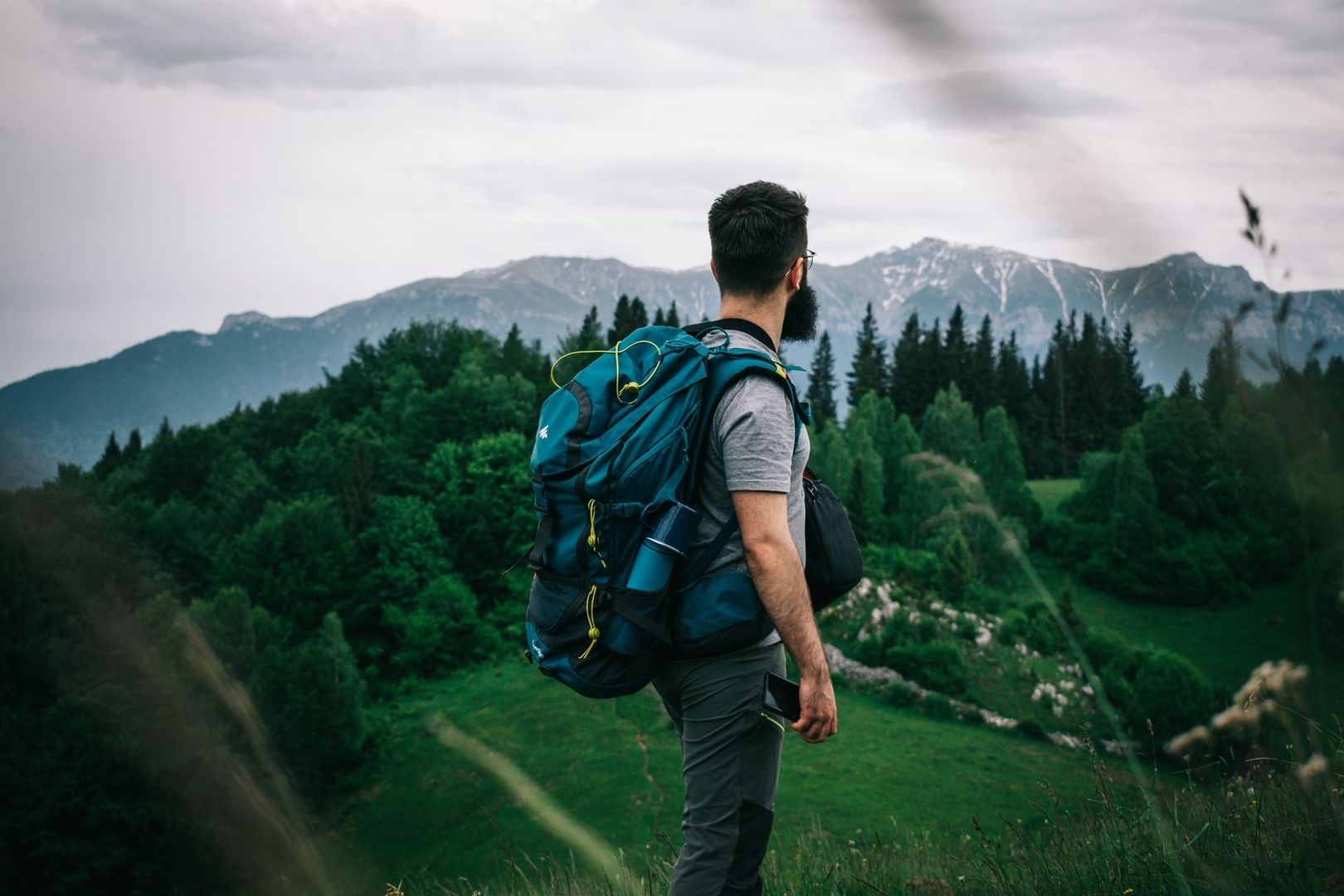
The first control point is the pack itself. Heavy equipment should sit as close as practical to the anatomical spine, with the hip belt carrying a substantial share of the weight and the shoulder straps holding the load securely without forcing the shoulders forward. A pack that hangs far behind the body creates a backward pull. A pack that is loaded heavily on one side produces lateral torque, requiring the trunk muscles to correct the imbalance with every step.
There is no single loading formula that suits every pack, body shape, or surface. Internal-frame packs generally benefit from dense items being placed close to the back, while the exact height requires experimentation. On irregular ground, a moderately low and central load often reduces side-to-side movement, whereas a very high load can make a step over a stile or rock feel top-heavy. Keep soft, light items at the bottom and place dense food, fuel, and cooking equipment close to the frame. Avoid allowing small items to shift inside the pack, since movement within the load can create delayed momentum just as the foot is landing.
Lateral tilt becomes particularly costly on narrow, windward coastlines. If the pack leans toward the exposed side, the body may compensate by bending away from it, shortening one leg”s effective reach and increasing strain through the lower back and outer hip. A sudden gust can then turn a minor imbalance into a sideways correction. Route planning across variable coastal elevations also requires disciplined attention to access and terrain; the Dorset Coast Path guidance is a useful example of why walkers should check route conditions and rights of way before setting out.
| Load position | Likely effect on technical ground |
|---|---|
| Dense items high and far from the back | Raises the centre of gravity and increases sway during turns or step-ups |
| Dense items low but loose | May feel stable initially, but shifting contents create delayed movement |
| Dense items central and close to the frame | Usually gives the most predictable response and reduces lateral torque |
| Uneven side pockets | Creates repeated corrective work through the trunk and hips |
Negotiating Wooden Stiles and Restrictive Kissing Gates
A stile should be treated as a short climbing movement, not as an ordinary step. Before committing, stop far enough back to inspect the landing side. Check whether the ground is muddy, sloping, or hidden by vegetation, and decide where the pack, feet, and hands will go. Tighten the hip belt and secure loose straps so they cannot catch on a post. If the stile has a ladder form, approach squarely rather than diagonally, because an angled ascent encourages the pack to swing away from the structure.
- Place the leading foot firmly on the lowest suitable step and establish a stable base before lifting the second foot.
- Keep the chest close to the stile, using the hands on the rails or top bar while the legs do the lifting.
- Move one limb at a time, pausing whenever the pack shifts or the landing is not fully visible.
- Turn the hips only after both feet are secure on the far side, then step down with the lower foot first.
- Recheck the pack and clothing before resuming normal pace, particularly if straps or side pockets passed close to the rails.
A kissing gate requires a different sequence because the body and pack must pass through a restricted arc. Open the gate as far as it allows, then place the feet through the gap before rotating the shoulders. Keep side pockets compressed and avoid carrying bottles or trekking poles horizontally, where they can snag the frame. With a large pack, angle the body slightly, allowing the hips and pack to follow the same curved path rather than twisting the torso sharply in one direction.
Three points of contact remain valuable whenever a stile has wet timber, uneven steps, or a steep landing. Two feet and one hand, or two hands and one foot, provide a stable base while the centre of gravity moves. Do not rush to regain walking speed. On routes with many gates and stiles, such as pasture crossings described along the Cumbria Way, repeated interruptions can become more tiring than the gradients themselves. A controlled pause at each obstacle generally costs less energy than recovering from a snagged strap or poorly placed foot.
Descending Polished Granite Risers and Wet Steps
Descending is often more demanding than climbing because the pack”s mass increases forward momentum while the quadriceps work eccentrically to slow the body. Damp granite and weathered stone add a second problem: the available friction can change from one foot placement to the next. Keep the body slightly flexed, shorten the stride, and lower the centre of gravity without leaning far backward. Excessive backward lean can cause the pack to pull the torso away from the feet, making a slip more difficult to arrest.
Place the foot on the most secure part of each riser, rather than stamping the entire sole flat onto an uncertain surface. A small edge, rough patch, or shallow depression may offer more grip than a smooth central section. Let the ankle and knee bend as the foot loads, allowing the joints to absorb small rotational forces. If the surface slopes sideways, aim the foot so that the knee tracks in the same direction as the toes, avoiding a twisted landing under full pack weight.
Technical coastal tracks demonstrate how quickly surfaces can change. The National Park Service describes the Great Head Trail in Acadia as a route combining ocean views, rocky granite terrain, short steep sections, and caution around steep drops. The lesson applies well beyond that specific trail: use appropriate footwear, inspect wet steps before descending, and do not let scenery draw attention away from the next two or three foot placements.
- Reduce stride length before the first steep riser, not after momentum has already built.
- Keep knees and ankles softly flexed so the legs can respond to uneven height and angle.
- Use a handhold where it is sound, but test it before transferring weight.
- Turn slightly across a broad slope only when the path is wide enough and the outer edge is secure.
- Stop on a stable platform to adjust clothing, poles, or pack straps rather than doing so mid-step.
Dynamic Trekking Pole Deployment on Exposed Cliffs
Trekking poles are most useful when they are deployed as reactive stabilizers rather than used as metronomic walking sticks. On a steep contour, the uphill pole may need to be shorter and the downhill pole longer, allowing both tips to reach the ground without forcing the shoulders into an awkward tilt. Make adjustments before the terrain becomes technical. Changing pole length while standing beside an exposed edge or on a wet step divides attention at precisely the wrong moment.
When the path narrows, place a pole deliberately on a stable patch of ground, load it briefly, and then move the opposite foot. The aim is to create a temporary tripod with the two feet and one pole, or with both poles when the surface and width permit. Pole support does not replace foot placement. Tips can slip on smooth rock, and a pole planted beyond the edge may pull the body in an unsafe direction. Keep wrist loops loose enough to release quickly, and avoid trapping the hands inside them during a scramble, gate crossing, or sudden fall. Poles can improve stability for heavy-pack travel, but they also occupy the hands, so stow them whenever careful hand contact with rock or a stile is more important.
- Shorten the uphill pole and lengthen the downhill pole for a steep side slope.
- Plant the tip slightly ahead and to the side, where it can resist a small shift without overreaching.
- Use alternating placements on regular ground, but switch to individual reactive placements on rock.
- Carry folding poles securely when hands are needed for ladders, gates, or scrambling.
Move With Confidence on Demanding Coastal Trails
Heavy-pack balance is built from several small decisions made continuously. The torso should remain calm while the feet read the surface. The pack should move with the body rather than behind it. Poles should be placed in response to the terrain, not simply swung according to a fixed rhythm. At each obstacle, reduce speed early, identify the landing, and preserve three points of contact whenever the structure or surface demands it.
With practice, stiles, gates, granite risers, and wet steps become rhythm changes rather than disruptions. The rhythm is deliberate: pause, inspect, position the load, place the foot, stabilise, and continue. That methodical approach protects joints and reduces fatigue across long stages, especially where exposure, wind, and repeated elevation changes compound the demands of a self-sufficient pack. Ambitious coastal treks are entirely compatible with heavy loads when movement is treated as an active skill and every difficult section is approached with measured, terrain-first judgement.